ICBC Road Test Guide: What to Expect and How to Prepare
If you are preparing for an ICBC road test, it is normal to wonder what the examiner will actually be watching for.
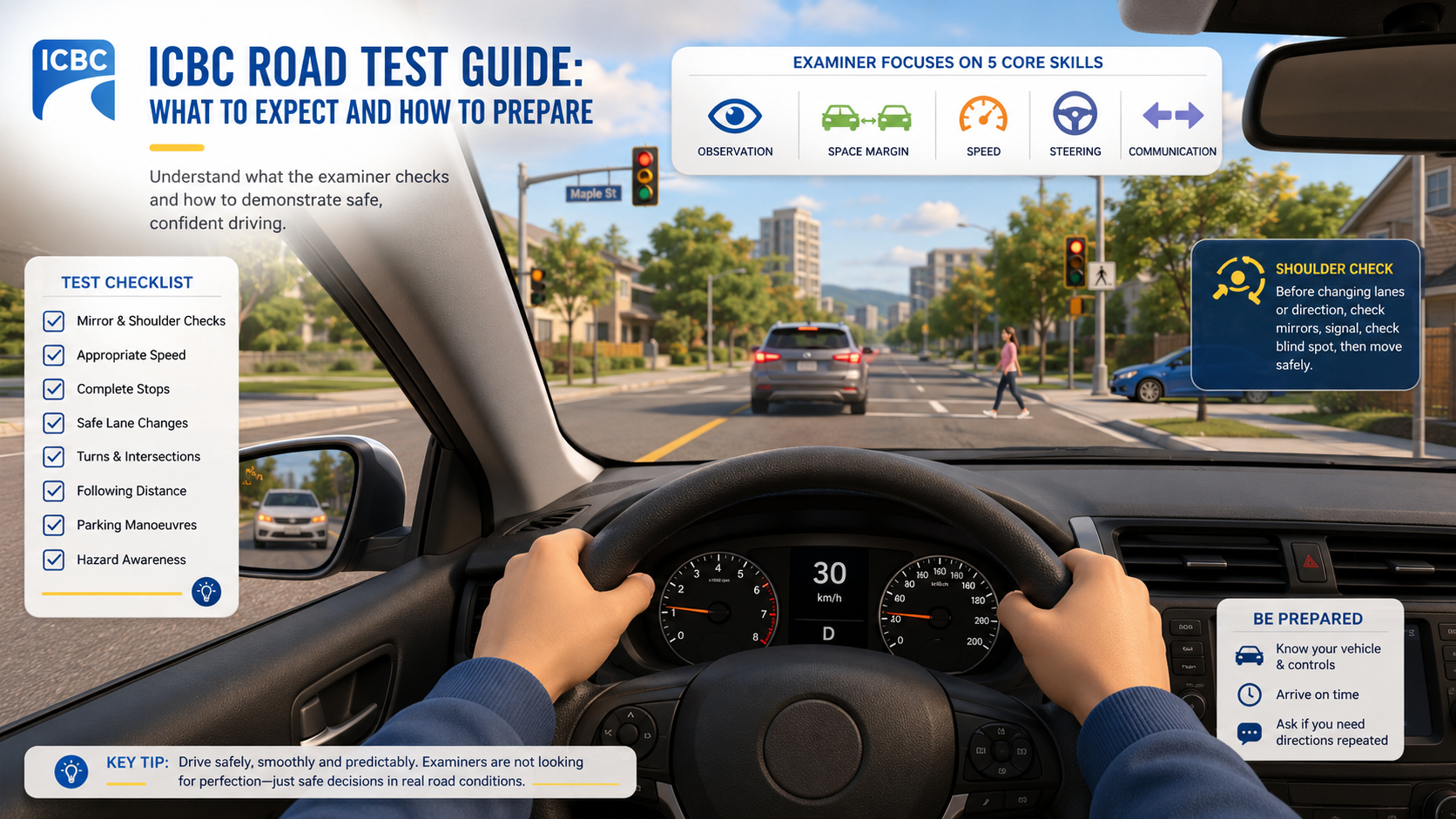
The short answer is that the examiner is assessing how safely, smoothly and controllably you demonstrate the required driving skills throughout the test. ICBC says examiners are not looking for perfection. Instead, they evaluate the skills you demonstrate while following the examiner’s directions and responding to the road environment. (ICBC)
The current ICBC Skills Explainer groups these skills into five core areas:
Observation
Space Margin
Speed
Steering
Communication
Those categories provide a useful framework for understanding what an examiner may be watching during your road test. (ICBC)
The important point is that you should not try to memorize a secret examiner formula. Your goal is to consistently demonstrate safe driving habits.
What Does the ICBC Examiner Check?
During the road test, the examiner observes your driving as you complete the required route and manoeuvres. The assessment is based on the skills you demonstrate rather than on whether every movement is perfectly executed. (ICBC)
In practical terms, the examiner may be watching how you:
observe your surroundings
use mirrors and shoulder checks
identify hazards
maintain appropriate speed
manage space around your vehicle
position the vehicle in the correct lane
communicate with signals
make turns and lane changes
stop correctly
control the vehicle while parking or reversing
steer smoothly
respond to changing traffic conditions
ICBC’s Skills Explainer provides specific assessment areas under Observation, Space Margin, Speed, Steering and Communication. It also identifies behaviours such as shoulder checks, mirror checks, 360-degree checks, following distance, safe gaps, lane position, speed maintenance and signalling. (ICBC)
The examiner is therefore looking at the quality and safety of your driving decisions, not simply whether you can operate the vehicle.
1. Observation and Shoulder Checks
Observation is one of the most important parts of safe driving because you need to know what is happening around your vehicle before you make a movement.
Shoulder Checks
A shoulder check is used to confirm that the blind spot beside your vehicle is clear before a relevant change in direction or road position.
ICBC’s Skills Explainer specifically identifies shoulder checks before changing direction, changing road position or pulling away from the curb. (ICBC)
For example, before changing lanes, your sequence should include:
Check your mirrors.
Signal your intended movement.
Check the appropriate blind spot.
Confirm that the gap is safe.
Move smoothly when it is safe to do so.
A common problem is making the shoulder check too late, too quickly or without actually looking far enough into the blind spot.
Your head movement should make it clear that you are checking the area that your mirrors cannot show you.
Mirror Checks and Scanning
Mirrors help you maintain awareness of what is happening around your vehicle.
ICBC identifies mirror checks when changing lanes, turning and pulling out from or toward the side of the road. It also emphasizes scanning, particularly when approaching areas where hazards may be present, such as intersections and crosswalks. (ICBC)
Do not think of observation as a single glance.
Good observation is continuous. As you approach an intersection, for example, you should be considering:
vehicles approaching from other directions
pedestrians
cyclists
traffic signals and signs
parked vehicles
potential conflicts
360-Degree Checks
Before reversing, you need to understand what is happening around the entire vehicle.
ICBC specifically identifies a 360-degree check before backing up. (ICBC)
This becomes particularly important during parking manoeuvres. Do not rely exclusively on mirrors or a reverse camera.
A camera can assist you, but it should not replace physically checking your surroundings.
2. Speed Control
Speed is not simply about staying below the posted limit.
You need to choose a speed that is appropriate for the conditions while remaining within the applicable speed limit. ICBC’s Skills Explainer identifies speed maintenance, complete stops, amber lights and smooth acceleration/deceleration as specific areas of assessment. (ICBC)
Maintaining an Appropriate Speed
Pay attention to:
posted speed limits
school zones
playground zones
construction areas
traffic conditions
road conditions
hills and changes in elevation
visibility
Speed limits can change when you enter certain zones, so actively scan for signs rather than assuming the previous limit continues.
ICBC also warns drivers to be aware of posted speed limits and changing limits in school, playground and construction zones. (ICBC)
Driving below the limit is not automatically safer if the speed is unnecessarily slow for the conditions. The objective is controlled, appropriate speed.
Smooth Stops and Acceleration
Good speed control also includes how you accelerate and decelerate.
Avoid:
unnecessary hard braking
abrupt acceleration
rolling through required stops
unnecessary slowing
inconsistent speed
ICBC identifies rolling stops as a specific speed-related assessment item and says the vehicle must come to a complete stop where required, including at stop signs, red lights and when exiting parking lots. (ICBC)
3. Turns and Intersections
Turns require several skills at the same time: observation, communication, speed control, positioning and steering.
Before the Turn
Before turning, consider:
your mirrors
your signal
your surroundings
pedestrians and cyclists
your lane position
your speed
whether a shoulder check is required
ICBC specifically advises drivers to scan when making a turn and to use appropriate observation and communication. (ICBC)
During the Turn
The vehicle should remain appropriately positioned throughout the manoeuvre.
Avoid:
turning too wide
cutting the corner
entering the wrong lane
approaching the turn too quickly
making unnecessary steering corrections
ICBC’s Skills Explainer identifies turn position as a space-margin skill and states that the vehicle should maintain a suitable lane position during the turn and finish in the correct lane. (ICBC)
After the Turn
Once the turn is complete:
establish the correct lane position
continue scanning
maintain appropriate speed
cancel the signal when the manoeuvre is complete
The goal is a controlled transition from one movement to the next.
4. Lane Changes
Lane changes are a good example of why the examiner is evaluating a sequence of decisions rather than one isolated action.
A useful practice sequence is:
Mirror → Signal → Shoulder Check → Safe Gap → Controlled Movement
The exact timing depends on the traffic situation, but the underlying principle is consistent: communicate your intention, check the space and make the movement only when it is safe.
ICBC’s Skills Explainer specifically covers mirror checks, shoulder checks, signalling, safe gaps and manoeuvre location. (ICBC)
Before changing lanes, ask yourself:
Do I have enough space?
Have I checked my mirrors?
Have I signalled?
Have I checked the blind spot?
Is another road user approaching?
Can I move without forcing another driver to change speed or position?
A technically correct signal does not make an unsafe gap safe.
5. Stopping and Space Management
Safe driving is also about the space you maintain around your vehicle.
Complete Stops
A complete stop is required in situations such as stop signs and red lights, as well as when exiting parking lots where a stop is required. (ICBC)
Avoid the habit of allowing the vehicle to creep forward when you should be fully stopped.
Pay attention to the correct stopping position as well. ICBC identifies stopping position as a specific space-margin skill. (ICBC)
Following Distance
Leave enough space between your vehicle and the vehicle ahead.
The appropriate distance can depend on speed, traffic and road conditions.
A useful question while practising is:
If the vehicle ahead suddenly slows down, do I have enough time and space to respond safely?
ICBC specifically lists following distance as a road-test skill. (ICBC)
Stop Position
Stopping too far from or too close to another vehicle can create problems.
When approaching an intersection, stop in the legally appropriate position while keeping crosswalks clear.
ICBC’s Skills Explainer includes both stopping distance and avoiding blocking crosswalks within its space-margin criteria. (ICBC)
6. Parking and Manoeuvres
Parking manoeuvres give the examiner an opportunity to observe several skills together.
These include:
observation
vehicle positioning
steering
speed control
space management
communication
Parallel Parking
During parallel parking, do not focus only on where the vehicle ends up.
Your observation and control during the manoeuvre matter too.
Practise:
checking around the vehicle
controlling your speed
maintaining appropriate space
steering smoothly
finishing in a safe and legal position
ICBC specifically recommends practising manoeuvres such as parallel parking before a road test. (ICBC)
Reverse-Stall Parking
Reverse-stall parking requires careful observation as well as vehicle control.
Before reversing:
check around the vehicle
complete the required 360-degree observation
identify pedestrians and other vehicles
reverse at a controlled speed
continue observing while moving
ICBC specifically identifies the 360-degree check before reversing and advises candidates to practise reverse-stall parking before the test. (ICBC)
Three-Point Turns / Other Manoeuvres
If a particular manoeuvre is part of your test requirements, practise it until you can perform it safely and smoothly without losing awareness of your surroundings.
Do not assume that an older road-test checklist applies unchanged to every current test.
For current manoeuvre requirements, consult the relevant ICBC road-test information before your appointment.
7. Hazard Awareness
Hazard awareness goes beyond simply noticing something on the road.
You need to recognize potential hazards and respond appropriately.
Examples include:
pedestrians approaching a crossing
cyclists beside your vehicle
vehicles entering traffic
parked vehicles that may obstruct your view
busy intersections
changing traffic signals
school and playground zones
construction areas
changing road conditions
ICBC identifies hazard perception as part of the Observation category in its Skills Explainer. (ICBC)
A useful habit is to ask:
What could change in the next few seconds?
For example, a parked vehicle may hide a pedestrian. A cyclist may be travelling beside you in a blind spot. A vehicle waiting at an intersection may suddenly enter your path.
Seeing the hazard early gives you more time to respond.
8. Vehicle Control and Steering
Vehicle control is not about making every steering movement look perfect.
It is about maintaining control of the vehicle while making safe, deliberate movements.
Pay attention to:
steering control
lane position
acceleration
braking
turning
steering recovery
controlled manoeuvres
ICBC’s Skills Explainer includes general steering and lane position within its assessment framework. (ICBC)
During turns, avoid cutting corners or turning too widely. During lane changes, avoid abrupt steering. During parking, keep your speed low enough that you can maintain control.
The objective is smooth, predictable vehicle movement.
9. What Happens Before the Road Test Starts?
There is more to preparing for the appointment than practising your driving.
Your vehicle must meet ICBC’s requirements, and the examiner checks the vehicle before the test. ICBC says a vehicle that is unsafe or does not meet legal requirements may result in the test being cancelled. (ICBC)
The examiner may also make sure you know the location and operation of required controls.
ICBC’s driver-examiner guidance has specifically discussed controls such as the horn, parking brake and turn signals, as well as demonstrating hand signals. (ICBC)
Before your appointment, review the current ICBC vehicle requirements rather than relying on an old checklist.
You should also arrive prepared with any questions you have about the test. ICBC says you can ask the examiner to repeat or clarify directions during the test, although the examiner is there to evaluate rather than teach. (ICBC)
ICBC Examiner Checklist: What to Practise Before Your Test
The following is a practical preparation checklist based on current ICBC guidance. It is not an official ICBC examiner checklist.
Before your test, make sure you have practised:
Mirror checks
Shoulder checks
360-degree checks
Intersection scanning
Hazard awareness
Appropriate speed control
Complete stops
Following distance
Signal timing
Safe lane changes
Controlled turns
Correct lane positioning
Parallel parking
Reverse manoeuvres
Three-point turns, if applicable to your test
Smooth steering
Vehicle controls
Responding appropriately to pedestrians and cyclists
Driving through school, playground and construction zones appropriately
Following road signs and posted instructions
ICBC’s current Skills Explainer is the best reference for understanding the skill categories used in the assessment. (ICBC)
Read More About ICBC guide.
Want to feel more confident before your ICBC road test? A focused road test preparation lesson with a local instructor can help you practise the skills that matter most—from observation and lane changes to intersections, parking, and common test-day situations—so you can approach your test feeling prepared, calm, and in control.
Want feedback before your road test?
Knowing what the examiner checks is useful. Getting feedback on your own driving can be even more useful.
A professional preparation lesson can help you identify habits that you may not notice while driving on your own.
Common Mistakes to Watch for Before Your Test
Instead of trying to memorize dozens of possible mistakes, focus on the habits that affect multiple parts of your driving.
Observation
Watch for:
missing shoulder checks
relying only on mirrors
failing to scan intersections
forgetting the 360-degree check before reversing
noticing hazards too late
ICBC has specifically identified insufficient observation and missing 360-degree checks as common road-test concerns. (ICBC)
Speed
Watch for:
speeding
inconsistent speed
unnecessary slow driving
failing to notice a changed speed limit
rolling stops
Pay particular attention to school, playground and construction zones.
Communication
Watch for:
late signals
missing signals
failing to cancel the signal after a manoeuvre
signalling without checking whether the movement is safe
ICBC’s Skills Explainer specifically addresses signal use, timing and cancellation. (ICBC)
Space
Watch for:
following too closely
selecting unsafe gaps
stopping too close to another vehicle
blocking a crosswalk
poor lane position
Steering
Watch for:
cutting corners
turning too widely
abrupt steering
unnecessary corrections
losing lane position
Parking
Watch for:
insufficient observation
rushing the manoeuvre
poor space management
relying exclusively on the camera
forgetting to check around the vehicle
What If You Are Nervous About the Examiner?
Feeling nervous before a road test is common. ICBC acknowledges that many candidates feel nervous and recommends gaining enough driving experience and practising the required manoeuvres before the test. (ICBC)
One of the most useful ways to reduce uncertainty is to know what to expect.
Before the appointment:
practise the skills you find difficult
drive in different traffic and road conditions
become comfortable with the vehicle you will use
review current ICBC guidance
arrive with enough time to settle in
prepare any questions you want to ask
You do not need to drive perfectly.
You need to demonstrate safe, controlled driving and respond appropriately to the road environment.
Frequently Asked Questions
What does an ICBC examiner check during a road test?
The examiner evaluates the driving skills you demonstrate during the test. ICBC groups these skills into Observation, Space Margin, Speed, Steering and Communication. Examples include shoulder checks, mirror checks, hazard awareness, following distance, speed control, lane position and signalling. (ICBC)
What skills does the ICBC examiner evaluate?
The current Skills Explainer identifies five core competency areas:
Observation
Space Margin
Speed
Steering
Communication
The individual assessment items within those categories cover behaviours such as scanning, shoulder checks, safe gaps, speed maintenance, steering control and signalling. (ICBC)
Does the ICBC examiner check shoulder checks?
Yes. Shoulder checks are specifically identified in ICBC’s Skills Explainer. They are used to check blind spots before relevant changes in direction, road position or when pulling away from the curb. (ICBC)
Does the examiner check your speed?
Yes. Speed maintenance is one of the identified assessment areas. ICBC says drivers should choose a speed that is consistent, within the speed limit and appropriate for the conditions. (ICBC)
What does the examiner look for during a lane change?
The examiner can assess several parts of a lane change, including observation, mirror checks, shoulder checks, signalling, safe gaps, vehicle position and controlled movement. (ICBC)
Does the examiner check parking?
Parking manoeuvres provide opportunities to demonstrate observation, space management, speed control and steering. ICBC specifically recommends practising manoeuvres such as parallel and reverse-stall parking before the test. (ICBC)
What is the 360-degree check?
It is an observation check around the vehicle before reversing. ICBC’s Skills Explainer specifically identifies looking around the vehicle before backing up to ensure the surroundings are clear. (ICBC)
What is the ICBC Skills Explainer?
The Skills Explainer is provided with road-test results and identifies the driving skills candidates need to demonstrate. ICBC currently organizes the skills into Observation, Space Margin, Speed, Steering and Communication. (ICBC)
What happens if the examiner sees a driving error?
An individual error should not automatically be described as an automatic failure. The outcome depends on the overall assessment and the applicable criteria. ICBC states that examiners evaluate the skills demonstrated during the road test and that drivers are not expected to demonstrate perfection. (ICBC)
For any current failure criteria or specific scoring question, use the current ICBC guidance.
How can I practise the skills an examiner checks?
Break your practice into the same broad skill areas: observation, space management, speed, steering and communication. Ask a qualified supervisor or instructor to watch for specific habits such as missed shoulder checks, poor following distance, late signals, inconsistent speed or weak parking observation.
Final Thoughts
An ICBC examiner checklist is useful as a preparation tool, but it should not become something you simply memorize.
The more useful approach is to build consistent habits:
Observe → communicate → choose a safe space → control your speed → steer smoothly → respond to hazards.
The current ICBC Skills Explainer gives you a framework for understanding the skills being assessed. (ICBC)
If you are unsure where your own driving needs improvement, professional feedback can help you identify specific habits to work on before your appointment.
check our Driving Lessons Packages.
Important: ICBC requirements and road-test procedures can change. Always check the current official ICBC information before your appointment.