Beginner Driving Lessons in North Vancouver
If you are preparing for your first driving lesson, it is normal to wonder what will happen once you get into the car. You may be excited, nervous, or unsure how much you are expected to know already.
The good news is that a first lesson is a starting point. You do not need to arrive knowing how to steer perfectly, judge every distance, or handle busy traffic on your own.
A beginner lesson is generally about becoming familiar with the vehicle, developing basic control, learning how to observe your surroundings, and beginning to connect those skills with safe driving decisions. The pace should reflect your experience and comfort level.
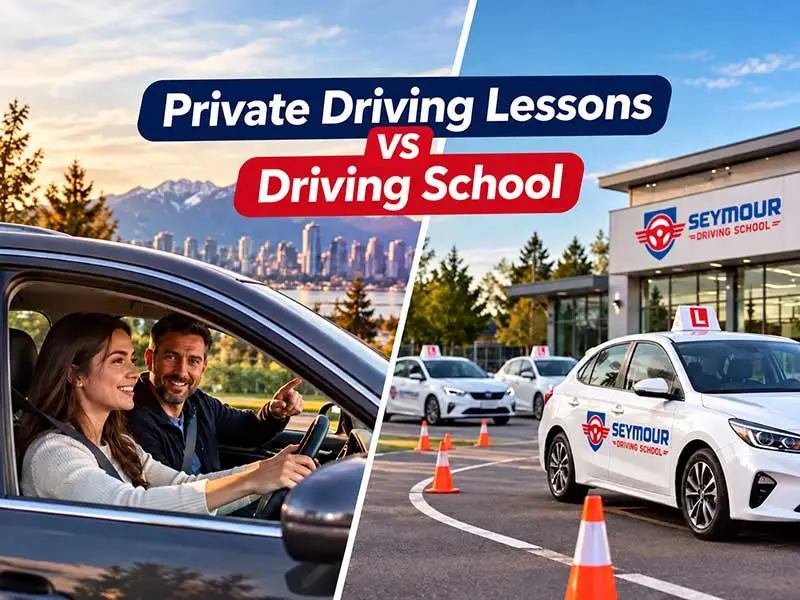
Seymour Driving School provides beginner-focused, personalized driving instruction for people who are learning to drive for the first time. Its current lessons page specifically identifies vehicle controls, steering, parking fundamentals, observation, traffic awareness and defensive driving as part of its beginner training. beginner driving lessons
What to Expect During Your First Driving Lesson
Your first lesson is unlikely to feel like a test. Instead, the instructor needs to understand where you are starting and help you build the basic skills needed for safe, controlled driving.
The exact sequence can vary depending on your experience, licence status, confidence and the instructor’s assessment of what you are ready to practise.
Before You Start Driving
Before the vehicle moves, there may be a short introduction and discussion about your experience.
If you have never driven before, tell your instructor. If you have driven occasionally with a qualified supervisor, have experience in another country, or have not driven for a long time, mention that as well.
This gives the instructor useful context.
You may also review basic vehicle setup, including:
- Seating position
- Steering wheel position
- Mirrors
- Seat belt
- Basic vehicle controls
- Turn signals
- Brake and accelerator pedals
- Gear selector, where applicable
The goal is not to memorize every control immediately. It is to become familiar enough with the vehicle that you can begin focusing on controlling it safely.
Getting Comfortable With the Vehicle
For a first-time driver, even simple controls can feel unfamiliar.
You may need time to understand how much steering input is required, how the vehicle responds when you release the accelerator, and how gently you need to use the brake.
A good beginner lesson gives you an opportunity to develop that feel gradually.
Your instructor may demonstrate a control first and then let you practise it. If something feels confusing, ask questions rather than trying to guess.
It is also completely reasonable to need more than one attempt.
Learning to drive is a physical skill as well as a decision-making skill. Repetition helps you develop smoother control.
What You’ll Learn During Your First Lesson
Your first driving lesson may introduce several foundational skills. The exact combination and order will depend on your starting point and the instructor’s assessment.
Starting and Stopping
Starting and stopping smoothly is one of the first basic skills many new drivers need to develop.
You may practise coordinating the vehicle’s controls, maintaining appropriate speed, and applying the brake progressively.
At first, it can be difficult to judge how much pressure is needed. That is normal.
Rather than trying to make every movement perfect immediately, focus on understanding how the vehicle responds to your inputs.
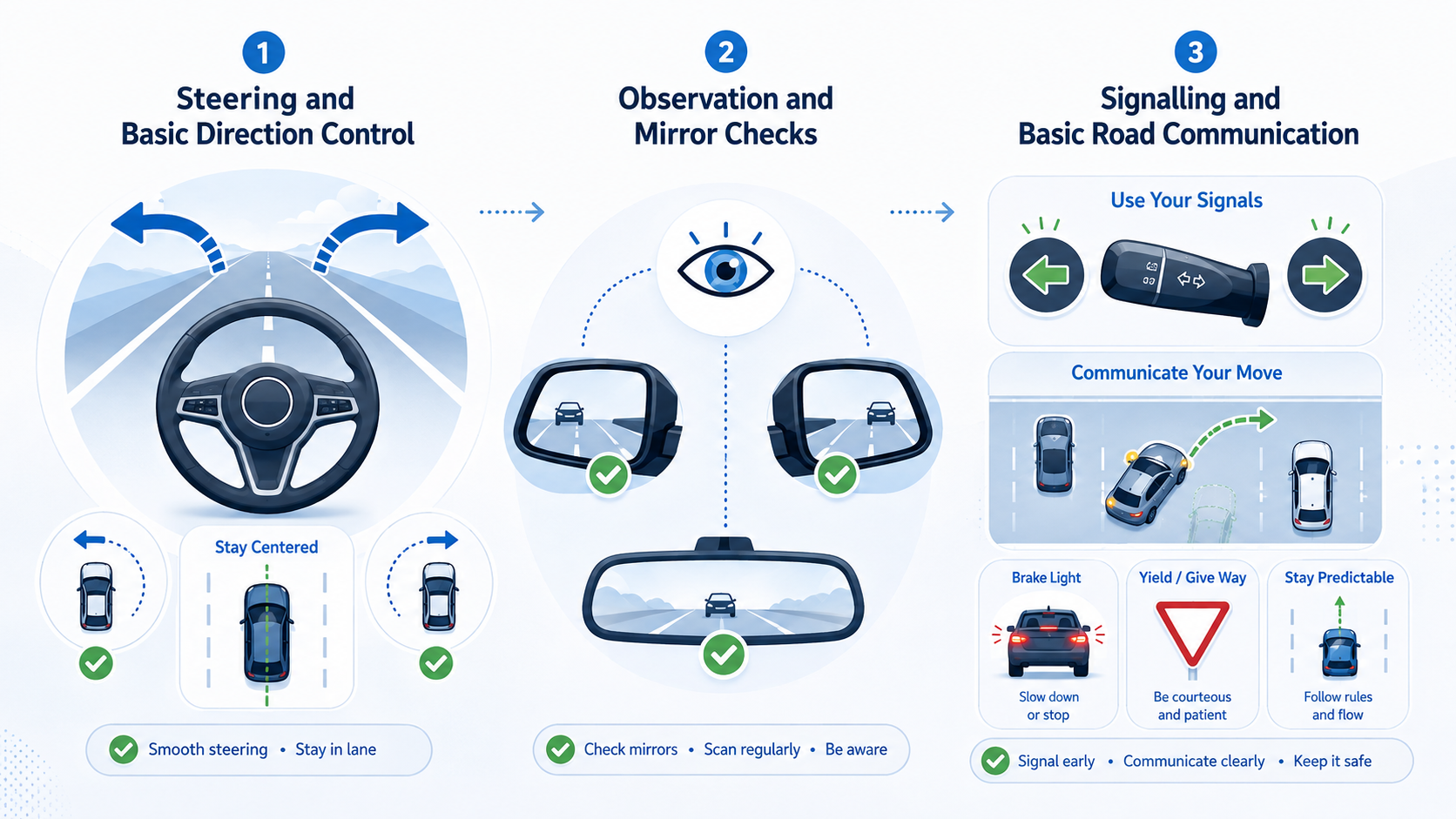
Steering and Basic Direction Control
Steering can look simple from the passenger seat, but controlling the vehicle accurately requires practice.
A beginner may initially concentrate too much on the steering wheel and not enough on where the vehicle is going.
Your instructor can help you develop a better visual reference by looking farther ahead, maintaining appropriate lane position, and making smooth steering adjustments.
The objective is not simply to turn the wheel. It is to learn how steering, speed, observation and road position work together.
Observation and Mirror Checks
Safe driving involves more than controlling the vehicle.
You also need to understand what is happening around you.
Early lessons can introduce the habit of checking mirrors, looking ahead, noticing other road users and identifying potential hazards before they become immediate problems.
This is one reason professional instruction can be useful for a new driver. An instructor can point out things that a beginner may not notice yet.
ICBC describes professional driver training as a way to help new drivers become comfortable handling a vehicle in different traffic and road conditions while developing driving skills and responsible habits.
Signalling and Basic Road Communication
Signals are an important part of communicating your intentions to other road users.
As you progress, your instructor may help you understand when signalling is needed and how it fits into your observation and decision-making process.
The important lesson for a beginner is that signalling should not be treated as an isolated action. You need to combine it with observation, positioning and awareness of surrounding traffic.
What If You’ve Never Driven Before?
You can tell your instructor that you have zero driving experience.
In fact, being honest about your experience level is one of the most useful things you can do at the beginning.
A complete beginner may need more time with basic controls before moving into more complicated traffic situations. Someone who has already driven regularly may be ready to work on different skills.
There is no benefit in pretending that you know something you do not.
If you are unsure how a control works, ask.
If you do not understand an instruction, ask for it to be explained another way.
If you feel overwhelmed, tell your instructor.
The purpose of professional instruction is to help you develop the skills progressively rather than expecting you to arrive fully prepared.
Seymour Driving School describes its approach as personalized instruction adjusted to the learner’s experience level, learning style and driving goals. (Seymour Driving School)
For learners beginning through B.C.’s Graduated Licensing Program, the learner’s licence is the first licensing step. ICBC states that you can obtain an L licence from age 16 after passing the required knowledge test and completing the licensing process. (ICBC)
How to Prepare for Your First Driving Lesson
A little preparation can make your first lesson feel much easier.
What to Bring
Bring the items required by your driving school and make sure you have the appropriate valid driver’s licence for the lesson.
Seymour Driving School’s current booking terms state that students must have a valid driving licence to be scheduled for driving hours. (Seymour Driving School)
If you use corrective lenses when driving, bring them.
You should also have any information the school has requested when arranging your lesson.
What to Wear
Choose clothing that allows you to move comfortably and footwear that lets you operate the pedals comfortably.
Avoid making your first lesson more difficult by wearing footwear that makes it hard to feel the pedals or clothing that restricts your movement.
Your goal is to be comfortable enough to concentrate on learning.
What to Do Before the Lesson
You do not need to spend hours trying to memorize every driving technique before your first lesson.
Instead:
- Arrive with enough time to get settled.
- Be honest about your experience.
- Tell your instructor if you feel nervous.
- Ask questions when something is unclear.
- Listen carefully to feedback.
- Give yourself permission to make mistakes while learning.
If you already have your learner’s licence, reviewing the official ICBC driving material can also help you understand the rules before you begin practising on the road. ICBC provides the Learn to Drive Smart guide and practice resources for new drivers. (ICBC)
Is It Normal to Feel Nervous?
Yes.
For many new drivers, the first time sitting behind the wheel can feel very different from watching someone else drive.
You may worry about:
- Pressing the wrong pedal
- Steering too much or too little
- Forgetting a signal
- Missing something around you
- Holding up other traffic
- Making a mistake in front of the instructor
These concerns do not mean you are bad at driving.
They are part of the uncertainty that comes with learning a new physical and decision-making skill.
The most useful approach is to communicate with your instructor. If you need an explanation repeated, ask. If you are unsure about what to do next, ask before acting.
A patient instructor can also help separate one mistake from the bigger learning process.
Seymour Driving School describes its instruction as calm, personalized and focused on practical confidence, which is particularly relevant for learners who are approaching driving for the first time. (Seymour Driving School)
If anxiety is one of your main concerns, you can also explore driving lessons for drivers.
What Happens After Your First Driving Lesson?
Your first lesson is only an introduction to the learning process.
After the initial lesson, your instructor can help identify the areas that need more practice and determine what to work on next.
For one learner, that might mean spending more time on vehicle control and observation.
For another, it might mean developing smoother turns, better lane positioning or greater confidence around intersections.
The progression should reflect the learner rather than a fixed promise about how quickly someone will become test-ready.
A useful progression may look something like:
Basic vehicle control → observation and awareness → road positioning → increasingly complex driving situations → independent skill development → appropriate licence or road-test preparation
The number of lessons needed will vary from person to person. There is no reliable universal number that can determine when a learner will be ready for every driving situation or test.
If your eventual goal is a road test, road-test preparation should be treated as a later stage of the learning process rather than the sole purpose of your first lesson.
For information about current B.C. licensing requirements and testing rules, use official ICBC guidance rather than relying on a driving school’s general explanation. ICBC’s new-driver resources provide the current graduated licensing information. (ICBC)
FAQ
What happens during your first driving lesson?
A first lesson generally begins with an assessment of your experience and an introduction to the vehicle and its controls. The instructor can then introduce basic driving skills such as starting, stopping, steering, observation and safe vehicle positioning according to your experience level. The exact sequence can vary.
What should I expect during my first driving lesson?
Expect to learn gradually rather than being expected to drive perfectly from the beginning. You may spend time becoming comfortable with the vehicle, practising basic control and learning how to observe your surroundings.
Do I need driving experience before my first lesson?
No previous driving experience is needed for a beginner-focused lesson. Tell the instructor that you are starting from zero so the lesson can be approached at an appropriate level. If you are learning under B.C.'s Graduated Licensing Program, make sure you have the appropriate learner's licence before driving on public roads. ICBC identifies obtaining the L licence as the first step in the program. (ICBC)
What do you learn in your first driving lesson?
Depending on your experience, you may work on vehicle controls, steering, braking, starting and stopping, observation, mirrors, signalling and basic road positioning.
Is it normal to feel nervous during your first driving lesson?
Yes. Driving is unfamiliar for many beginners, and it is normal to feel uncertain when you first start. Tell your instructor if you are nervous so they can understand your starting point and communicate with you appropriately.