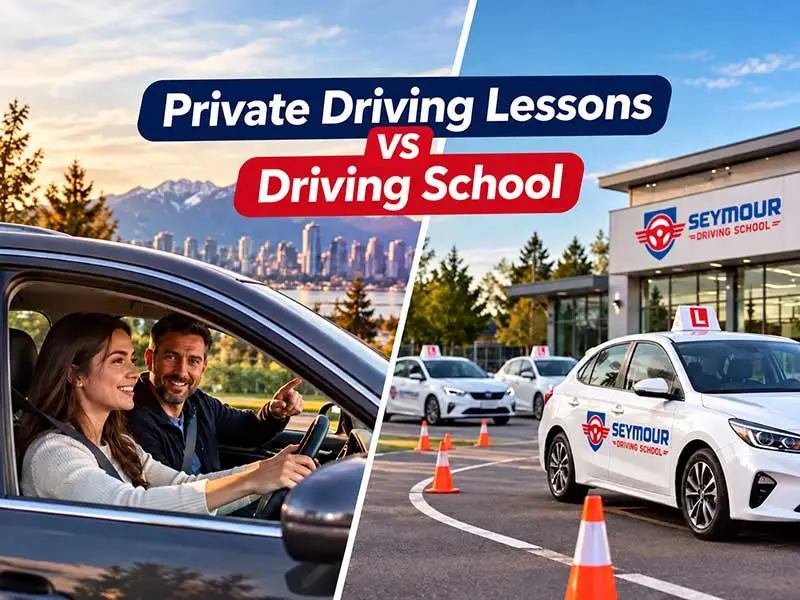
Choosing how to learn to drive is not simply a choice between paying by the hour and buying a course. Private Driving Lessons vs Driving School comes down to how much structure, flexibility, individual attention, and officially recognized training you need.
Driving education is regulated provincially in Canada, so course requirements and licensing benefits differ between British Columbia, Ontario, and other provinces. For Vancouver learners comparing local training options, Seymour Driving School offers one-to-one instruction alongside Driving Lesson Packages in Vancouver, making it possible to choose the amount and structure of training that fits your experience.
Private Lessons vs Driving School Compared: Quick Comparison
The main difference is not necessarily the instructor sitting beside you both options can involve one-to-one in-car instruction. The bigger difference is whether you are booking individual lessons around specific skills or following a structured program with defined training requirements.
| Factor | Private Driving Lessons | Structured Driving School Program |
What to Check Before Booking |
|
Training style |
Usually focused on the skills you personally need | Follows a planned progression covering broader driving skills |
Ask how your progress will be assessed |
|
Scheduling |
Usually easier to book lesson by lesson | May involve a defined course schedule and completion period |
Check evening, weekend and cancellation policies |
|
Personalisation |
High; lesson time can target specific weaknesses | Structured, although practical lessons can still be personalised |
Ask whether training can be adapted to your skill level |
|
Theory training |
Often limited unless specifically included | Approved programs may include formal theory and practical instruction |
Confirm exactly what the course includes |
|
Cost |
Pay only for the number of lessons required | Higher upfront cost, but packages may reduce the effective cost per lesson |
Compare total training hours, not only package price |
|
Road-test preparation |
Useful for targeted work on parking, observation or confidence | Often integrated into a broader progression from beginner skills to test readiness |
Ask whether mock road tests are included |
|
Provincial benefits |
Individual lessons normally do not create course-completion benefits by themselves | An approved provincial program may provide licensing benefits |
Verify the school and course with the provincial authority |
|
Best suited to |
Learners who already have experience or need help with particular skills | Complete beginners or learners who want systematic training |
Choose based on your current ability, not only price |
In British Columbia, paid practical driver training must be provided through properly licensed driver-training arrangements. ICBC states that practical driving instructors must be licensed and work at a driver training school. Some licensed schools also offer ICBC-approved GLP courses, which have additional requirements and benefits beyond ordinary individual lessons.
Pros and Cons of Private Driving Lessons
Private lessons generally mean one-to-one instruction booked individually rather than enrolment in a complete structured course. They can be highly effective when the learner already knows which areas need improvement.
Advantages of Private Driving Lessons
The biggest advantage is personalization. If your lane changes are strong but parallel parking is weak, an instructor can spend most of the session correcting that specific problem instead of following a broad beginner curriculum.
Scheduling can also be easier. Students balancing university, work, or family commitments may prefer booking individual sessions as needed rather than committing to a full program.
Private lessons are particularly useful for drivers who already have some experience. Someone preparing for a road test may only need help with observation routines, parking, merging, speed control, or confidence in heavier traffic.
They can also control short-term costs. Instead of paying for a complete course upfront, a learner can book one lesson, receive professional feedback and then decide how much additional training is actually necessary.
Potential Drawbacks of Private Lessons
Flexibility can become a weakness if there is no clear training plan. A learner may repeatedly practice the skills they already find comfortable while overlooking hazard perception, defensive driving, adverse-weather techniques, or other important areas.
The total cost can also increase if lessons are booked without measurable progression. Ten disconnected sessions are not automatically better than six well-planned sessions.
Most importantly, individual lessons should not be confused with an approved driver-education course. In BC, for example, an ICBC-approved Class 7 GLP course includes formal course requirements and at least 32 hours of instruction across classroom and on-road learning. Ordinary private lessons do not automatically provide the same course-completion status.
Pros and Cons of Driving School Programs
A driving school program is designed to create progression. Instead of deciding what to practice at the start of every session, the learner works through a broader training plan covering knowledge, vehicle control, observation, hazard awareness, and increasingly complex road conditions.
Benefits of a Structured Driving School Program
For a complete beginner, structure helps prevent gaps in learning. Basic vehicle control can be established before moving into intersections, lane changes, parking, higher-speed roads, and more complex traffic.
Approved programs can also provide province-specific benefits.
In British Columbia, an ICBC-approved GLP course can shorten the required safe-driving period for eligible drivers under 25 from 24 months to 18 months. That remains part of the updated GLP framework taking effect on October 19, 2026. Approved courses may also provide two Grade 11 credits for eligible high-school students.
Ontario works differently. A government-approved Beginner Driver Education course includes at least 20 hours of classroom or digital instruction, 10 hours of in-vehicle training, and 10 hours of flexible instruction. Successful completion can reduce the Level One waiting period by four months, and an insurer may offer a discount, although Ontario explicitly states that an insurance discount is not guaranteed.
These examples show why learners should check whether a program is officially approved in their province rather than assuming that every driving-school package provides licensing or insurance advantages.
Potential Drawbacks of Driving School Programs
The most obvious disadvantage is the higher initial commitment. A full program can cost more upfront than booking one or two individual lessons.
A structured curriculum may also include areas you already know well. An experienced learner who only needs help with parallel parking and road-test observation may not need a complete beginner program.
Scheduling can sometimes be less flexible because approved courses may have required components, minimum training hours, and completion deadlines.
The important distinction is therefore between structure and unnecessary training. A complete program is valuable when you need the full learning pathway; it is less efficient when only a small number of specific skills need work.
Driving School vs Private Instructor: Cost, Flexibility and Training
When comparing Driving School vs Private Instructor, looking only at the advertised hourly price can lead to the wrong conclusion. The useful comparison is total cost versus the amount and type of training you actually need.
Which Option Costs Less?
Private lessons can cost less when the learner already has substantial supervised driving experience and needs only a few professional sessions.
For example, someone who drives regularly with a qualified supervisor but struggles with parking or lane changes may only require targeted instruction. Paying for a full beginner course would provide training that person may not need.
A school package can offer better value when many hours of instruction are required. Package pricing may lower the effective cost of each lesson and may include additional services such as progress tracking, mock road tests, or use of a training vehicle.
Approved programs can also have non-price benefits that affect overall value. In BC, an approved GLP course can shorten the safe-driving period for eligible younger drivers; in Ontario, approved BDE training can shorten the Level One waiting period.
Therefore, the cheapest hourly lesson is not necessarily the cheapest route from beginner to competent driver.
Which Offers More Flexible Scheduling?
Individual private lessons normally provide greater flexibility because sessions can be added, reduced, or spaced according to the learner’s availability and progress.
They are particularly practical for shift workers, university students, or anyone who cannot maintain a fixed weekly schedule.
Structured programs may still offer flexible appointment times, but the learner has to complete the required components of the course. The real question to ask a school is not simply whether it offers evening or weekend appointments, but how easily lessons can be rescheduled and how long students have to complete the program.
Which Provides More Structured Training?
A complete driving-school program generally provides the stronger framework because skills are taught in a planned sequence and progress can be measured against defined learning objectives.
This is particularly important for someone with no previous driving experience. Beginners do not always know which skills they are missing, so relying entirely on self-selected practice can create gaps.
Private instruction can still be highly structured when delivered by a strong professional instructor. The difference is that the structure usually comes from an individual lesson plan rather than from a complete approved curriculum.
For this reason, learners should ask prospective instructors how they assess progress, what they teach before road-test preparation begins, and how they decide when a student is ready to move to more complex driving situations.

Which Option Is Right for You?
The right choice depends mainly on your starting point. A learner with zero experience has very different training needs from someone who has already completed months of supervised practice.
Complete Beginners
A structured driving-school program usually makes the most sense when you are starting from zero.
The benefit is progression: vehicle controls and basic observation come first, followed by intersections, lane positioning, parking, hazard awareness, and more demanding driving situations.
For new drivers in BC who want the official benefits of driver education, it is important to verify that the specific course, not simply the school, is ICBC-approved. A licensed driving school can offer regular lessons without every course it sells necessarily being an approved GLP program.
Learners Preparing for a Road Test
If you already drive safely and independently under the conditions allowed by your license, targeted private lessons may be more efficient.
A professional instructor can identify specific problems such as missed shoulder checks, poor speed control, weak intersection scanning, parking errors, or hesitation during lane changes.
In this situation, a small number of focused sessions combined with a mock road test may provide more value than restarting a full beginner curriculum.
Drivers Who Only Need Extra Practice
Private lessons are often the practical choice for someone who already understands road rules but needs confidence in a specific environment.
That might include highway merging, downtown traffic, night driving, rain, parking, or returning to driving after a long break.
The key is to book instruction around a clearly defined goal. Before the first lesson, tell the instructor what you find difficult and ask for an assessment. After the session, you should know what needs improvement, what to practice between lessons, and whether another professional lesson is actually necessary.
Ultimately, Private Lessons vs Driving School Compared is less about one option being universally better and more about matching the training format to the learner. Structured programs are strongest when you need a complete foundation and potentially province-recognized benefits; private lessons are strongest when you need flexibility, personalized correction, and focused practice.
FAQs
Is private or school driving better?
Neither option is better for everyone. Private driving lessons are usually better for learners who already have some experience and need flexible, targeted practice. A driving school program is often more suitable for complete beginners who need structured training and a clear learning path.
What is the cheapest way to learn to drive?
The cheapest option depends on how much training you need. If you already practice regularly with a qualified supervisor, a few targeted private lessons may cost less. If you need many hours of professional training, a driving school package can offer better overall value than paying for individual lessons one at a time.