Choosing between automatic and manual driving lessons usually comes down to what you want to learn, what type of vehicle you expect to drive, and how comfortable you are with learning additional vehicle controls.
For a beginner, an automatic vehicle removes clutch operation and manual gear changes from the early learning process. A manual vehicle adds those skills, including coordinating the clutch, accelerator and gear selection. Neither choice is automatically better for every learner.
The most useful question is not simply, “Which one is easier?” It is:
Which type of vehicle best matches the way you expect to drive after your lessons?
If you are still deciding, a qualified driving instructor can help you understand what each option involves before you commit to a particular training approach.
know more about Seymour Driving Lessons .
Automatic vs Manual Driving Lessons: Which Is Right for You?
The main difference is the amount of vehicle control you need to manage while driving.
With an automatic transmission, the vehicle handles gear changes for you. You still need to learn steering, braking, acceleration, lane positioning, observation, traffic awareness, parking, reversing and safe decision-making.
With a manual transmission, you also need to learn clutch control and gear selection. That means coordinating several additional actions while continuing to observe the road and respond to traffic.
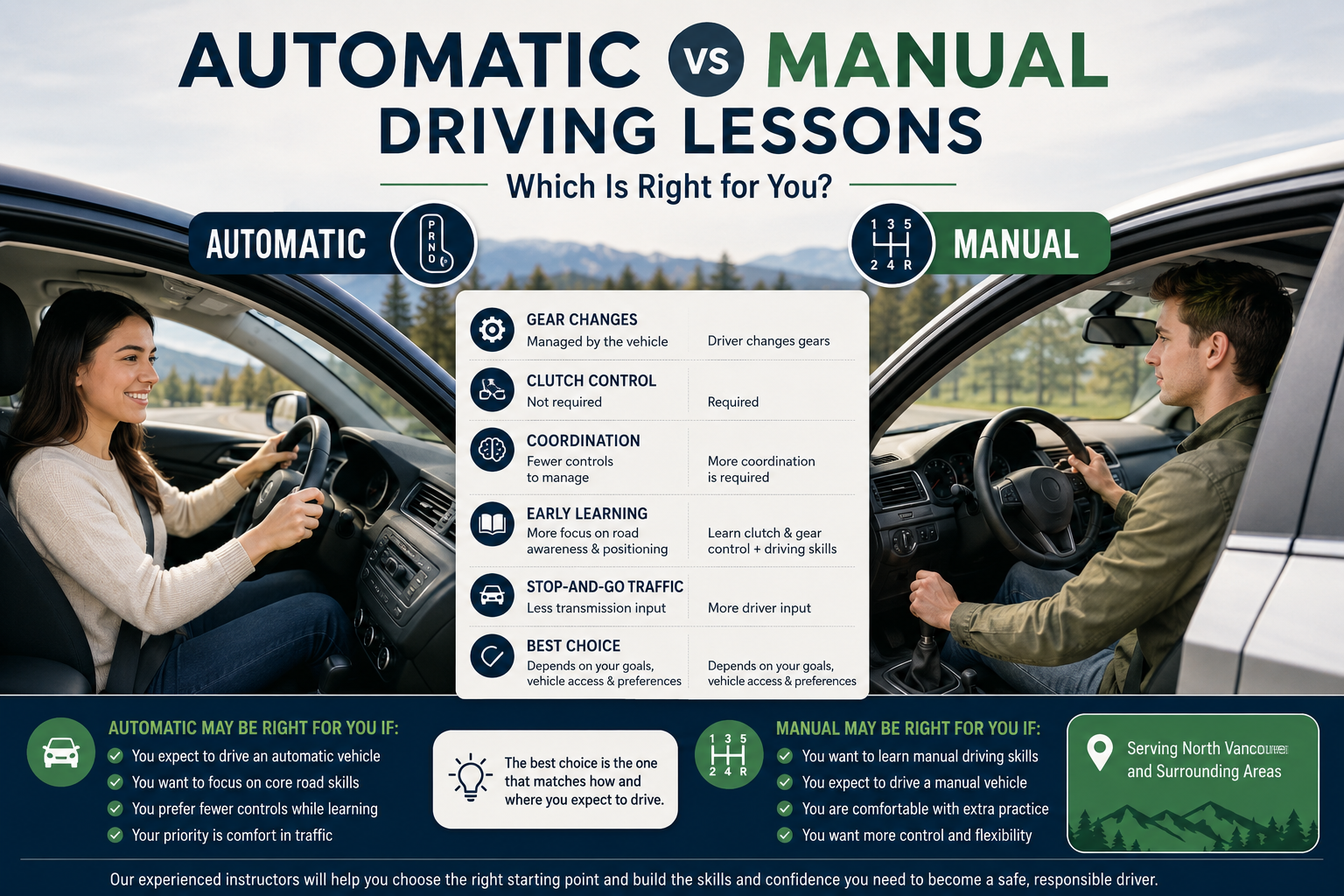
| Consideration | Automatic | Manual |
|---|---|---|
| Gear changes | Managed by the vehicle | Driver changes gears |
| Clutch control | Not required | Required |
| Coordination | Fewer transmission-related controls | More coordination is required |
| Early learning | May allow more attention for road awareness and vehicle positioning | Requires learning clutch and gear control alongside other driving skills |
| Stop-and-go traffic | Less transmission input | More driver input |
| Best choice | Depends on learner needs and vehicle access | Depends on learner goals and available vehicle |
For someone having their first experience behind the wheel, reducing the number of controls to manage can make it easier to concentrate on the fundamentals of driving. That does not mean learning in an automatic is effortless. A new driver still has to develop good observation, speed control, positioning and decision-making habits.
Manual driving adds another layer of coordination. For some learners, that is exactly what they want to develop. For others, it can take additional practice before clutch and gear changes become comfortable.
The right choice depends on the individual learner rather than a rule that one transmission is always better.
What Is Different About Learning in an Automatic?
An automatic vehicle allows a beginner to focus on the core skills involved in operating safely in traffic without having to coordinate a clutch pedal and manual gear changes.
During early lessons, attention can be directed toward:
- steering and vehicle control
- accelerator and brake control
- lane positioning
- checking mirrors and blind spots
- identifying hazards
- approaching intersections
- maintaining an appropriate speed
- parking and reversing
- communicating with other road users
For a new driver, these are already substantial skills to learn.
A practical example
Imagine a learner approaching an intersection for the first time. In an automatic vehicle, the learner can concentrate primarily on speed, positioning, observation and what is happening around the vehicle.
That does not remove the need for careful instruction. It simply means the learner is not simultaneously trying to coordinate clutch engagement and gear selection.
As confidence develops, the focus can move toward more complex traffic situations and independent decision-making.
The important point is that automatic driving lessons should still build complete driving skills rather than allowing the learner to focus only on operating the pedals.
What Is Different About Learning in a Manual?
Manual driving introduces additional vehicle-control skills.
A learner needs to become comfortable with:
- clutch engagement
- selecting the appropriate gear
- coordinating clutch and accelerator use
- changing gears smoothly
- moving away from a stop
- controlling the vehicle on inclines
- avoiding unnecessary stalling
- maintaining road awareness while managing these controls
These skills can initially require considerable attention.
A learner might, for example, concentrate heavily on finding the clutch engagement point while moving away from a stop. An instructor can then help the learner practise the movement until it becomes more consistent and requires less conscious effort.
This is one reason manual learning can feel more demanding at first. The learner is developing vehicle-control skills while also learning the same essential road skills required in an automatic vehicle.
However, the difficulty is highly individual. Previous driving experience, coordination, confidence and the amount of practice all influence how quickly a learner becomes comfortable.
A real instructor observation is more useful than a generic claim because it shows what learners actually encounter during lessons.
How Should a Beginner Choose Between Automatic and Manual?
There is no single answer that applies to every new driver.
A useful way to decide is to consider your learning priorities, the vehicle you expect to drive and your current experience.
Consider Your Learning Priorities
If your immediate priority is developing core road skills with fewer vehicle controls to manage, an automatic may be a practical starting point.
If you specifically want to develop clutch and gear-changing skills, a manual may be the better fit.
Think about what you want to be comfortable doing when your lessons are finished, rather than choosing a transmission simply because someone else recommends it.
Consider the Vehicle You Will Actually Drive
One of the most practical questions is:
What type of vehicle are you likely to drive after your lessons?
If your household or future vehicle is automatic, learning in an automatic may provide a more directly relevant experience.
If you expect to regularly drive a manual vehicle, learning manual controls during instruction may make sense.
Vehicle availability matters too.
Do not assume that every driving school, instructor or training vehicle offers both options.
Consider Your Current Skill Level
A completely new driver and someone with previous experience are not necessarily starting from the same place.
A learner with no previous driving experience may initially need to focus on basic vehicle control, observation and traffic awareness.
Someone who has already driven in another country or has experience with one transmission may be approaching the decision from a different starting point.
If you have previous experience, tell your instructor what you have already driven and what feels unfamiliar. That information can help shape the lesson rather than repeating skills you already understand.
What About Automatic vs Manual Driving in British Columbia?
If you are learning to drive in British Columbia, licensing requirements are an important part of the decision.
ICBC currently identifies an automatic-transmission restriction as one possible licence restriction. In other words, transmission-related restrictions can exist under BC’s licensing system. The specific restriction applicable to a driver depends on the circumstances of their licence and should be checked against current ICBC requirements.
This should not be interpreted as meaning that every learner must learn manual, or that learning manual automatically provides broader licensing privileges.
For current licensing and testing requirements, check the applicable ICBC information before making a decision.
Because licensing policies can change, Seymour Driving School should not rely on an old explanation of automatic-versus-manual rules when advising learners.
Automatic or Manual: Which Should You Learn?
A simple way to approach the decision is to start with your intended driving situation.
An automatic may make sense if:
- you expect to drive an automatic vehicle
- you want to concentrate initially on core road skills
- you prefer fewer transmission-related controls while learning
- your priority is becoming comfortable with general vehicle operation and traffic
A manual may make sense if:
- you specifically want to learn manual driving skills
- you expect to drive a manual vehicle
- you are interested in learning clutch and gear coordination
- you are comfortable allowing additional practice time for these skills
Neither list makes one transmission universally better.
Your expected vehicle, learning preferences, previous experience and current BC licensing requirements are more useful factors than a general claim that one option is always easier.
If you are unsure, discussing your goals with an instructor before booking can help you choose an appropriate lesson approach.
Frequently Asked Questions
Is automatic easier to learn than manual?
Automatic vehicles generally require fewer transmission-related controls because the vehicle manages gear changes and does not require the driver to operate a clutch.
That can allow a beginner to focus more directly on steering, observation, positioning and traffic awareness.
Manual driving adds clutch and gear-control skills, which can require additional coordination and practice. However, the overall learning experience varies from one person to another.
Can a beginner learn to drive a manual car?
Yes, a beginner can learn manual driving skills with appropriate instruction and practice.
The learner needs to develop clutch control, gear selection, smooth starts and gear changes while also building the observation and traffic-management skills required for safe driving.
Should I learn automatic or manual first?
Start with the type of vehicle that best matches how you expect to drive.
If you expect to drive an automatic, learning in an automatic may be the most directly relevant option. If you specifically expect to drive a manual, learning manual controls from the beginning may be appropriate.
If you are uncertain, discuss your intended vehicle and learning goals with your instructor.
Does automatic or manual affect my BC driver’s licence?
It can be relevant because ICBC recognizes automatic-transmission restrictions as a type of licence restriction. The exact rules depend on the driver’s circumstances and current licensing requirements.
Do not rely on general online advice for your specific licensing situation.
Can I switch from automatic to manual later?
You can learn additional manual-driving skills after learning in an automatic vehicle.
However, moving to manual means learning clutch control, gear selection and coordination that are not required when operating a conventional automatic vehicle. The amount of additional practice required depends on the learner.
If you think you may eventually drive a manual vehicle, it is worth considering that goal when choosing your initial training approach.
What should I choose for my first driving lesson?
Choose the transmission that best fits the vehicle you expect to use and the skills you want to develop.
If you are completely new to driving and are unsure which option is appropriate, speak with your instructor about your goals before the lesson.
Choosing the Right Starting Point
Automatic and manual driving lessons teach the same essential foundation of safe driving: observation, vehicle control, positioning, speed management, hazard awareness and responsible decision-making.
The difference is the additional vehicle-control work involved in manual driving.
If you expect to drive an automatic, an automatic lesson can help you focus on the fundamentals without learning clutch and gear changes at the same time. If you specifically want to drive a manual vehicle, learning those controls from the beginning may better match your goal.
The best choice is the one that matches how and where you expect to drive.
For learners in North Vancouver and surrounding communities, Seymour Driving School can help you determine an appropriate starting point based on your goals and available instruction.
Ready to start learning? Book a driving lesson and discuss the best lesson approach for your needs with Seymour Driving School.