
Four-way stop intersections can be confusing, especially when several drivers arrive almost simultaneously. Understanding who should proceed first is an important driving skill and a useful part of ICBC road test preparation in British Columbia. The basic principle is simple: the first vehicle to stop generally goes first. When vehicles arrive together, their positions and intended directions determine who must yield.
These intersections are common in residential neighborhoods throughout North Vancouver, Vancouver, West Vancouver, and Burnaby. Knowing the rules helps prevent hesitation, unexpected movements, and avoidable conflicts. If you’re preparing for your full license, class 5 driving lessons can help you practice judging right-of-way situations in real traffic. Here’s how to approach each situation safely.
4-Way Stop Right-of-Way Rules in BC: Quick Reference
| Traffic Situation | Who Goes First? | What You Should Do |
| One vehicle stops before everyone else | The first vehicle to stop | Allow that vehicle to proceed before taking your turn. |
| Two vehicles stop simultaneously on adjacent roads | The vehicle on the right | Yield if the other vehicle is to your right. |
| Opposite vehicles arrive together; one turns left, one goes straight | The straight-moving vehicle | The left-turning driver waits. |
| Opposite vehicles arrive together; one turns right, one turns left | Generally, the right-turning vehicle | The left-turning driver yields to conflicting oncoming traffic. |
| Four vehicles stop at approximately the same time | No automatic first vehicle | Avoid competing for priority; establish a safe, predictable order. |
| A pedestrian is crossing your intended path | The pedestrian | Remain stopped until you can proceed safely. |
| A school bus displays flashing red lights | Special school bus stopping requirements apply | Stop as required and wait until permitted to proceed. |
| Another driver enters out of turn | Safety takes priority | Yield if necessary to prevent a collision. |
| You cannot see approaching traffic clearly | Proceed only when visibility is sufficient | Recheck the intersection before moving. |
4 Way Stop Rules BC: Understanding Right of Way
The 4-way stop rules bc drivers follow are based on arrival order, vehicle position, and turning direction. Every approaching driver must make a complete stop before deciding when to proceed.
Who Goes First at a 4-Way Stop?
The first vehicle to arrive and stop completely normally proceeds first. For example, if you stop before a vehicle approaching from your left, you generally take your turn first, even if that driver intends to travel straight and you’re turning. However, having priority never removes your responsibility to check that the intersection is clear.
What Happens When Two Cars Arrive at the Same Time?
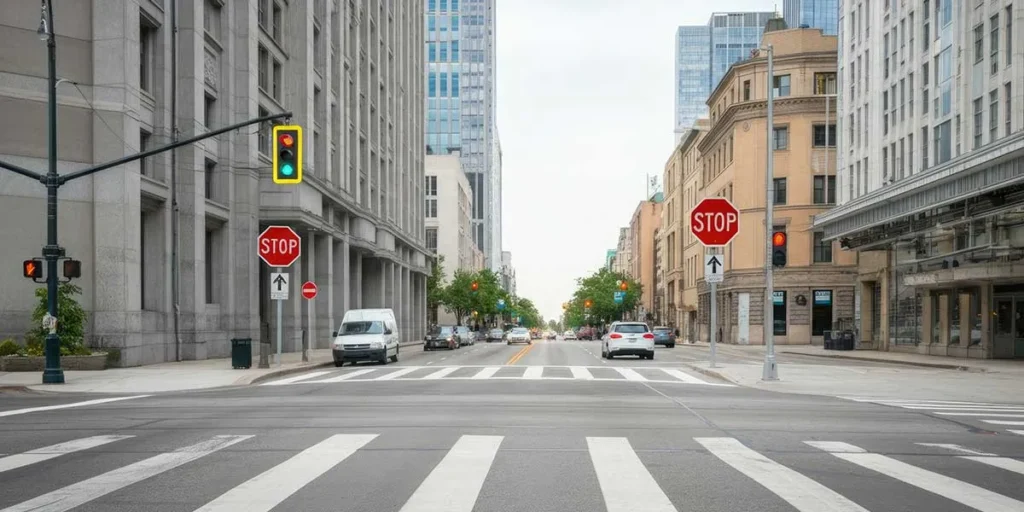
When vehicles on adjacent approaches stop simultaneously, the driver on the left yields to the driver on the right. Imagine you’re facing north and another vehicle arrives from the road to your right. That vehicle should proceed first. If three or four vehicles arrive together, avoid competing for space. Watch for clear intentions, let uncertainty resolve, and proceed only when safe.
Who Has Priority When Turning Left?
If two opposite-facing vehicles stop at approximately the same time, the driver turning left yields to an oncoming vehicle traveling straight. The same principle generally applies when the opposing driver is turning right and the vehicles’ paths conflict. One important distinction: if the left-turning vehicle clearly stopped first, the usual first-arrival rule still matters. Never assume a straight-moving vehicle automatically goes first regardless of arrival order.
How to Approach and Cross a 4-Way Stop Safely
Knowing the rules is only part of safe intersection driving. Your stopping position, observation, and timing are equally important.
Where and When to Come to a Complete Stop
Reduce speed smoothly as you approach the intersection. Stop before the marked stop line. If there is no line, stop before the crosswalk. Where neither exists, stop before entering the intersection. Your wheels must stop completely. Rolling through a stop sign is not an acceptable substitute, even when no other vehicles are visible.
Checking for Pedestrians and Cyclists
Before moving, scan the sidewalks, crosswalks, and approaching traffic. Pay particular attention to cyclists approaching from either side and pedestrians who may be partially hidden by parked vehicles. A pedestrian crossing your path takes priority over your intended movement. Don’t assume an intersection is clear simply because the other cars are waiting.
When Is It Safe to Enter the Intersection?
Proceed only when it’s your turn and your intended path is clear. Check left, center, and right, then confirm that other vehicles have stopped or are yielding appropriately. Avoid rushing because another driver appears impatient. A short, deliberate pause to verify safety is better than entering an uncertain situation.
4 Way Stop Bus Rules: School Buses and Public Transit
The 4-way stop bus rules require an important distinction between ordinary buses and school buses displaying warning signals. A public transit bus approaching a four-way stop generally follows the same intersection rules as other vehicles. It does not automatically go first simply because it’s larger.
However, BC also has a separate rule requiring drivers to yield to qualifying transit buses leaving stops on roads with speed limits of 60 km/h or less when the required yield sign and turn signal are displayed. School buses are different. When a stopped school bus displays alternating flashing red lights, drivers approaching from either direction must stop as required by BC law. Do not proceed until the bus moves or the driver indicates that it is safe. Always watch for children near the bus, even after its lights have stopped flashing.
Common 4-Way Stop Mistakes That Can Cause Accidents
Many intersection problems begin with incorrect assumptions rather than complicated traffic situations.
Watch for these common mistakes:
- Rolling stops: Slowing down without bringing the vehicle to a complete stop.
- Ignoring arrival order: Assuming the vehicle traveling straight always has priority.
- Forgetting the right-side rule: Moving first when an adjacent vehicle arrived simultaneously on your right.
- Misreading turn signals: Trusting an indicator without checking the vehicle’s actual movement.
- Unnecessary hesitation: Remaining stopped long after your turn becomes clear and safe.
- Following another vehicle through: Entering without making your own complete stop and observations.
The same defensive-driving principle applies when learning how to merge onto a highway safely: anticipate other drivers’ actions without assuming they’ll always follow the rules.
4 Way Stop Rules Canada: What BC Drivers Should Know
The 4-way stop rules Canada drivers commonly learn share similar principles: stop completely, respect arrival order, and yield appropriately when vehicles arrive together. However, specific traffic laws, enforcement practices, and special vehicle requirements are established by each province. If you’re searching for 4-way stop rules CA, make sure your source refers to Canada rather than California, which also uses the abbreviation CA.
In British Columbia, ICBC’s Learn to Drive Smart guide is a reliable reference for intersection procedures. The essential 4-way stop rule to remember is that being first doesn’t mean proceeding blindly. You must always consider pedestrians, conflicting traffic, and the actual situation.
What ICBC Examiners Look for at 4-Way Stops
During a road test, demonstrating safe intersection habits matters more than memorizing a sequence of rules. Your driving should demonstrate complete stops, correct positioning, effective scanning, appropriate yielding, and smooth decisions when it’s safe to proceed.
Examiners also assess how you respond to developing hazards. For example, if another driver unexpectedly enters the intersection, avoiding a collision takes priority over insisting on your turn. Practicing different intersection situations with Seymour Driving School can help you develop reliable judgment rather than relying on guesswork during your test.
Frequently Asked Questions
Are 4 Way Stops Dangerous?
Four-way stops are designed to manage conflicting traffic movements, but collisions can occur when drivers fail to stop, misunderstand priority, or overlook pedestrians. Clear observation, predictable movements, and proper yielding reduce these risks.
Do 4 Way Stops Have Cameras?
Some intersections may have traffic-monitoring or enforcement cameras, but cameras are not automatically installed at every four-way stop. Their presence and purpose depend on the location and local enforcement arrangements.
What Are Rules for a 4 Way Stop?
Under the four-way stop rules bc drivers learn to stop completely, allow the first vehicle to proceed, yield to the vehicle on your right when adjacent vehicles arrive together, and yield appropriately when turning left. Always check for pedestrians before entering.
When Approaching a 4 Way Stop, Who Goes First?
The vehicle that arrives and stops first generally proceeds first. If two vehicles on adjacent roads stop simultaneously, the vehicle on the right goes first. When opposite vehicles arrive together, a left-turning driver yields to conflicting straight-through traffic.