A traffic light turns yellow just as you approach an intersection. Should you brake or keep driving? In British Columbia, the answer depends on whether you can stop safely before entering the intersection. Making that decision correctly is an important driving skill, especially during icbc road test preparation. Understanding the law, anticipating signal changes, and recognizing your vehicle’s stopping distance can help you respond calmly instead of making a last-second decision.
Yellow Traffic Lights in BC: Quick Decision Guide
| Driving Situation | What You Should Do | Important Safety Detail |
| Yellow appears while you’re still well away from the intersection | Slow down and stop | Stop before the marked crosswalk |
| You’re too close to stop safely | Continue cautiously | Maintain a controlled speed; never accelerate to beat the light |
| A green light has been on for a while | Anticipate a possible change | Check your mirrors and prepare to brake |
| You’re already legally waiting inside the intersection to turn left | Complete your turn when safe | Yield to oncoming traffic and pedestrians |
| Roads are wet or slippery | Plan for a longer stopping distance | Reduce speed before reaching the intersection |
| Yellow appears during your ICBC road test | Stop unless stopping cannot be done safely | Demonstrate controlled braking and good judgment |
| The signal turns red before you reach the intersection | Stop before entering | Do not enter against the red light |
What Does a Yellow Traffic Light Mean in BC?
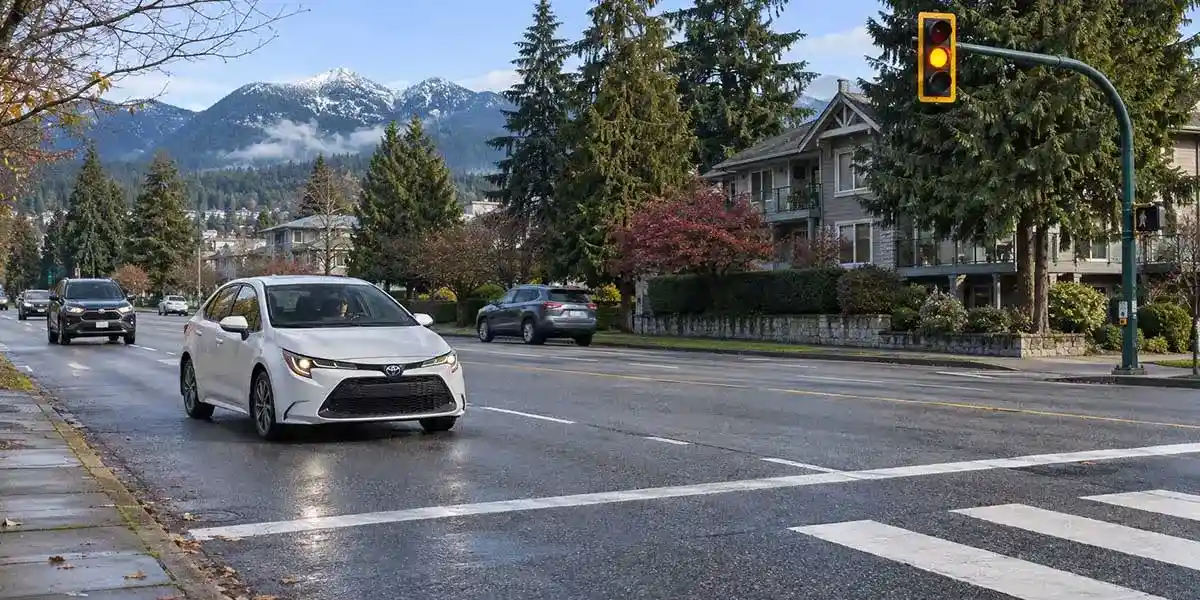
If you’re wondering what does a yellow traffic light mean, British Columbia’s Motor Vehicle Act provides a clear answer: a steady yellow light means you must stop unless stopping cannot be done safely.
Under Section 128, drivers approaching a yellow signal must stop before the marked crosswalk, or before entering the intersection if no marked crosswalk exists, unless they cannot stop safely.
Unlike a green light, yellow does not give drivers a general opportunity to proceed. It warns that the signal is changing to red and requires an immediate, safety-based decision.
Yellow Traffic Light Rules: When Must You Stop?
The most important part of yellow traffic light rules is recognizing when you have enough time and distance to stop smoothly.
If the signal changes while you’re approaching at a reasonable distance, ease off the accelerator and apply the brakes progressively. Avoid abrupt braking when a controlled stop is possible.
This judgment becomes more natural with experience. During class 5 driving lessons, drivers can practise recognizing changing signals, maintaining appropriate approach speeds, and stopping at the correct position.
For example, imagine approaching an intersection in North Vancouver at 50 km/h. If the light turns yellow while you have sufficient distance to brake comfortably, you should stop.
Remember that your stopping distance includes both the distance travelled while reacting and the distance required to brake. Wet pavement, downhill roads, and reduced tire traction can increase that distance.
When Is It Safer to Continue Through a Yellow Light?
Sometimes, stopping after a light turns yellow would require dangerously hard braking. British Columbia’s rules recognize this situation. ICBC describes a useful concept called the point of no return: the point during your approach beyond which you can no longer stop safely.
Consider a driver travelling at 50 km/h who is only a short distance from the crosswalk when the signal changes. If stopping would require emergency braking, continuing at a controlled speed may be the safer response.
A practical decision involves three factors:
- Distance: Can you stop before the crosswalk without harsh braking?
- Road conditions: Will rain, ice, or a downhill slope affect braking?
- Surrounding traffic: Is another vehicle following closely, and how might it respond?
A vehicle behind you does not automatically justify continuing. You must assess the actual risk and whether a safe stop remains possible. The key is to anticipate the change early. Never increase your speed simply because the light has turned yellow.
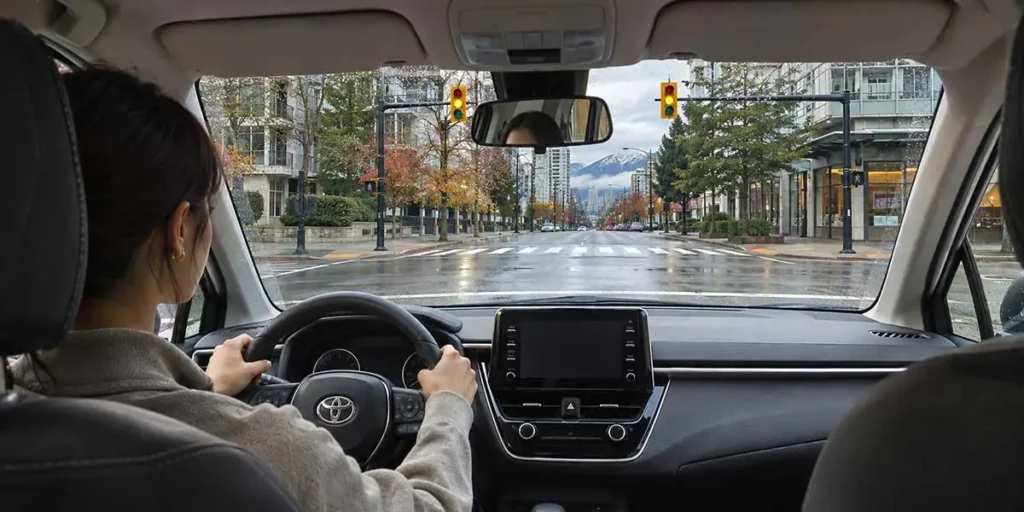
How Long Does a Yellow Light Last in British Columbia?
Drivers often ask, how long does a yellow light last before turning red?
There is no single duration that applies to every signalized intersection in British Columbia. Yellow-light timing depends on traffic engineering considerations, including approach speed and intersection design. If you’re asking how long is a yellow light at a particular intersection, its timing must be determined from that signal’s configuration rather than assumed from other intersections.
However, knowing the approximate timing should not influence your decision to accelerate through the intersection. For example, a yellow signal on a higher-speed road may be timed differently from one at a lower-speed urban intersection. Instead of counting seconds, evaluate your distance, speed, and ability to stop safely.
Practical tip: When approaching a green light that has been illuminated for some time, consider that it may change before you reach the intersection. ICBC calls this a stale green light. Reduce pressure on the accelerator and prepare for a possible stop.
Running a Yellow Light: Common Mistakes to Avoid
Running a yellow light can create unnecessary risk when drivers treat the signal as an invitation to hurry.
Common mistakes include:
- Accelerating toward the intersection: Speeding up reduces your reaction time and may lead to entering after the signal turns red.
- Braking at the last second: Delayed decisions can cause harsh stops or increase rear-end collision risks.
- Watching only the signal: Drivers must also monitor pedestrians, cyclists, vehicles, and intersection conditions.
- Following the vehicle ahead automatically: Another driver’s decision to proceed does not mean it is safe for you.
- Entering without an available exit: Never enter an intersection if traffic congestion prevents you from clearing it.
Another situation that deserves attention is turning at traffic lights. Yellow-light decisions and right turns at a red light involve different legal requirements, including stopping and yielding. A reliable driving habit is to assess the intersection before reaching it, not after the light changes.
Yellow Light Rules for Your ICBC Road Test
Understanding yellow light rules is particularly important during an ICBC road test because examiners assess both traffic-law compliance and safe decision-making. ICBC’s Road Test Skills Explainer identifies amber-light handling as an assessed driving skill. Drivers are expected to stop before entering the intersection unless they cannot safely stop in time.
During your test, demonstrate that you can:
- Anticipate signal changes without driving unnecessarily slowly.
- Check surrounding traffic as you approach intersections.
- Brake smoothly when there is enough stopping distance.
- Continue only when stopping safely is not possible.
- Maintain awareness of pedestrians, cyclists, and cross traffic.
Road test example: You’re approaching a green light on a rainy Vancouver street. It changes to yellow while you’re still far enough away to stop comfortably. The correct response is to brake smoothly and stop before the crosswalk.
If you accelerate unnecessarily instead, the examiner may record an error. Remember that a safe decision matters more than trying to keep moving. Your goal is to demonstrate consistent, predictable driving.
Drive with Confidence at BC Intersections
Good driving means knowing when to stop, when continuing is necessary, and how to make that decision without panic. At Seymour Driving School, our instructors help drivers build these skills through practical, personalized lessons across North Vancouver, Vancouver, West Vancouver, and Burnaby.
Book a driving lesson and build confidence at every intersection.
Frequently Asked Questions
Can You Go Through a Yellow Light in BC?
Yes, but only when stopping safely is not possible. Under British Columbia’s Motor Vehicle Act, drivers must stop at a steady yellow light unless they cannot do so safely. Accelerating to get through before the light turns red is not an appropriate response.
Do You Have to Stop at a Yellow Light in British Columbia?
Yes. Stopping is required when it can be done safely. Drivers should stop before the marked crosswalk or, where there is no marked crosswalk, before entering the intersection. Road conditions, vehicle speed, and stopping distance all affect the decision.
Can You Fail Your ICBC Road Test for Going Through a Yellow Light?
Yes, an unsafe or unlawful decision at a yellow light can contribute to failing your ICBC road test. However, proceeding when stopping safely is impossible is not automatically an error. The examiner evaluates the circumstances, your judgment, and your overall driving performance.