Learning to drive in Vancouver means dealing with more than basic vehicle control. New drivers need to understand British Columbia’s licensing rules while becoming comfortable with rain, cyclists, busy intersections, changing speed limits, and dense urban traffic.
These tips for new drivers in Vancouver focus on the habits and rules that matter most in everyday driving. For anyone looking for structured practice, Seymour Driving School can help turn these rules into real-world driving skills, while Driving Lesson Packages in Vancouver can provide more consistent practice before an ICBC road test.
|
Rule / Situation |
What the Rule Actually Means |
What a New Driver Should Do |
|
L licence |
You must drive with a qualified supervisor aged 25+ in the front passenger seat, display the red L sign, carry only one passenger in addition to the supervisor, and not drive between midnight and 5 a.m. |
Before driving, check that your supervisor qualifies, your L sign is visible and you are within the permitted driving hours. From October 19, 2026, the minimum supervisor age drops to 22. |
|
N licence |
You may drive alone, but you must display the N sign. You are normally limited to one passenger unless the passengers are immediate family or a qualified supervisor is with you. |
Do not assume an N licence has the same freedoms as a full Class 5 licence. Check who is in the vehicle before every trip. |
|
Alcohol, drugs and phones |
L and N drivers must have zero alcohol and zero drugs in their blood. They also cannot use handheld or hands-free electronic devices while driving. |
Set navigation and music before moving. Do not use your phone even while stopped at a red light. |
|
Following distance |
Keep at least 2 seconds behind the vehicle ahead in good conditions, 3 seconds on high-speed roads and 4 seconds in bad weather or on slippery roads. |
Choose a fixed object ahead. When the vehicle in front passes it, count the seconds until you reach the same point. |
|
Driving in rain |
Wet roads increase stopping distance and reduce grip, so the posted speed limit may still be too fast for the conditions. |
Increase your following gap to about 4 seconds, brake earlier and avoid sudden steering or braking. |
|
Passing cyclists |
Leave at least 1 metre when the speed limit is 50 km/h or lower and 1.5 metres when it is above 50 km/h. |
Slow down, wait until there is enough room to pass safely and never squeeze past a cyclist because traffic behind you is waiting. |
|
Turning across a bike lane |
Drivers must yield to cyclists travelling through the area and should shoulder-check before turning. |
Before a right turn: signal, check your mirrors, shoulder-check for cyclists and turn only when the path is clear. |
|
School zones |
Unless otherwise posted, Vancouver school zones are generally 30 km/h from 8 a.m. to 5 p.m. on school days. Some arterial school zones may be posted at 40 km/h. |
Do not rely on memory alone. Look for the actual speed sign when entering every school zone. |
|
Playground zones |
The usual playground-zone limit is 30 km/h from dawn to dusk every day, unless signs say otherwise. |
Reduce speed before entering the zone rather than braking after you have passed the sign. |
| Intersections | Cyclists and pedestrians are especially easy to miss when turning, and many cyclist crashes occur at intersections. |
Before moving through or turning at an intersection, scan left, centre and right, then check again for pedestrians and cyclists before completing the turn. |
Tips for New Drivers in Canada: BC Rules You Should Know
Driving rules for beginners vary across Canada, so tips for new drivers Canada should always be checked against the province where you are licensed. In Vancouver, new drivers follow British Columbia’s Graduated Licensing Program (GLP).
L and N Driver Restrictions in BC
A Class 7L learner currently needs a qualified supervisor aged 25 or older with a valid Class 1–5 license seated beside them. Learners must display the red L sign, may carry only one passenger in addition to the supervisor, cannot drive between midnight and 5 a.m., and must have zero alcohol or drugs in their blood. Personal electronic devices, including hands-free devices, are also prohibited.
After passing the Class 7 road test, an N driver must display the N sign. N drivers are generally limited to one passenger unless the passenger is an immediate family member or a qualified supervisor is present. Zero-alcohol/drug and electronic-device restrictions continue to apply.
New Driver Rule Changes in 2026
Important changes take effect on October 19, 2026. The second road test currently used to exit the GLP will be replaced by a Driving Record Assessment for eligible drivers with a safe driving record. After upgrading, drivers enter a 12-month Class 5 restricted period requiring zero blood alcohol and zero blood drug content.
For drivers under 25, the novice period remains 24 months, or 18 months after completing an approved GLP course. For drivers aged 25 or older, the new system reduces the learner phase to nine months and the novice phase to 12 months. The minimum age for a qualified supervisor will also drop from 25 to 22 under the new rules.
Until October 19, the current GLP rules remain in effect.
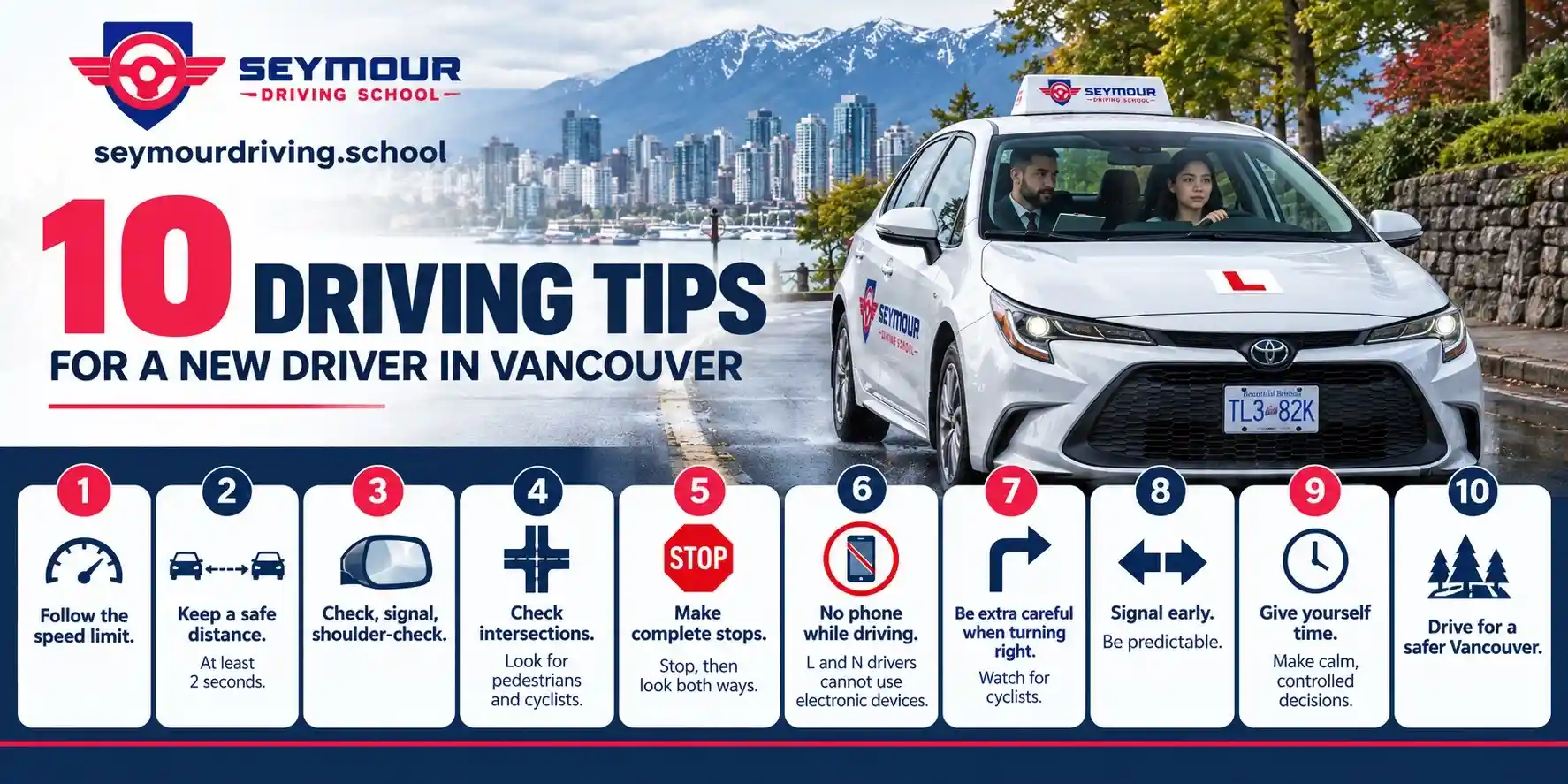
10 Driving Tips for a New Driver in Vancouver
These driving tips for a new driver focus on decisions that prevent common mistakes rather than simply helping someone pass a test.
Speed, Following Distance and Safe Lane Changes
- Follow the posted speed limit. Do not copy faster traffic around you. Pay particular attention when entering school, playground, construction, or neighborhood slow zones.
- Use the two-second rule. ICBC recommends at least two seconds behind another vehicle in good conditions, three seconds on high-speed roads, and four seconds in bad weather or on slippery roads.
- Create a safe gap before changing lanes. Check your mirror, signal, shoulder-check the blind spot, and move only when enough space is available.
Mirrors, Shoulder Checks and Intersections
- Shoulder-check before every change of direction. This includes lane changes, merging, pulling away from the curb, and many turns.
- Scan intersections before entering. A green light does not guarantee the intersection is clear. Look for pedestrians, cyclists, and vehicles that may enter unexpectedly.
- Check carefully before turning right. Cyclists can approach alongside your vehicle, particularly where a bike lane runs beside the road.
- Make complete stops. At a stop sign, stop in the correct position first, then scan before moving. These observation habits are also specifically emphasized in ICBC road-test guidance.
Avoid Distractions and Drive Predictably
- Put your phone away before moving. L and N drivers cannot use personal electronic devices while driving, including hands-free systems.
- Signal early enough to communicate your intentions. Avoid sudden lane changes, late turns, or unnecessary braking.
- Give yourself time to make decisions. Safe driving is not about being fast or excessively cautious. Predictable, controlled decisions give other road users time to respond.

Tips for Driving in Vancouver
For a new driver, Vancouver roads can feel demanding because vehicles regularly share space with cyclists, pedestrians, buses, and other vulnerable road users. These tips for driving in Vancouver address some of the conditions beginners encounter most often.
Driving Tips in Vancouver for Rain and Poor Visibility
Rain reduces traction and increases stopping distance. ICBC advises drivers to slow down, increase their following distance, and allow at least twice the normal braking distance on wet roads. In poor conditions, increase your following gap to about four seconds.
One of the most useful driving tips in Vancouver is to adjust your speed to conditions rather than simply driving at the maximum posted limit. Keep your windscreen clear, make sure your wipers are effective, and avoid abrupt steering or braking on wet surfaces.
Cyclists, Pedestrians and Bike Lanes
Before turning right across or beside a bike lane, shoulder-check and yield to cyclists traveling straight through. Check again before opening a parked vehicle door.
BC rules require drivers passing vulnerable road users to leave at least 1 meter where the speed limit is 50 km/h or lower and 1.5 meters where it is above 50 km/h.
At intersections, scan crosswalks and sidewalk corners before turning. Vancouver specifically advises drivers not to drive, stop, or park in designated bike lanes and to yield to people walking or cycling when turning.
School Zones and Busy Intersections
Unless signs indicate otherwise, Vancouver lists the general city-road limit as 50 km/h, school zones at 30 km/h from 8 a.m. to 5 p.m. on school days, playground zones at 30 km/h from dawn to dusk, street bikeways at 30 km/h and lanes at 20 km/h.
However, Vancouver is expanding 30 km/h neighborhood slow zones, and some school corridors have different posted limits. Read the signs on the road rather than assuming a limit from memory.
Common Mistakes Every New Driver in Vancouver Should Avoid
Many beginner mistakes come from poor observation rather than difficult maneuvers. Common problems include following too closely, missing shoulder checks, entering intersections without scanning, overlooking cyclists before right turns, and failing to notice a change in the speed limit.
Another mistake is driving too cautiously in situations where a clear decision is required. Excessive hesitation can make your intentions difficult for others to understand. Instead, observe early, decide when it is safe, communicate with your signal, and complete the maneuver smoothly.
In rain, avoid treating the posted limit as a target. Your speed should always match visibility, traction, and traffic conditions.
Advices for New Drivers Preparing for the ICBC Road Test
Preparing for the ICBC road test is not about memorizing a route or performing differently for the examiner. The aim is to show that you can make safe, consistent decisions in normal traffic and respond correctly to changing road conditions.
One of the most important areas to practice is observation. New drivers should build a reliable routine of checking mirrors, signaling and shoulder-checking before turning, changing lanes, merging or moving away from the curb. Intersection scanning is equally important, especially where pedestrians, cyclists or limited visibility are involved.
Before your test, make sure you are comfortable with:
- mirror, signal and shoulder-check routines;
- scanning intersections before entering or turning;
- making smooth, complete stops;
- parallel and reverse-stall parking;
- hill parking and basic turning maneuvers;
- adjusting your speed when limits change;
- recognizing school, playground, and construction zones; and
- driving safely in different traffic and weather conditions.
Practicing in only one familiar area can leave you unprepared for unexpected situations. Gain experience on different roads, at different times of day, and in a range of weather conditions so you become comfortable adapting your speed, following distance, and observations.
Most importantly, make these behaviors part of your normal driving routine. Consistent observation, safe spacing, and good speed control will help during the ICBC road test, but they are even more important once you begin driving independently.
Frequently Asked Questions
What are the restrictions for new drivers in BC?
BC’s Graduated Licensing Program places different restrictions on L and N drivers. L drivers need a qualified supervisor aged 25 or older, cannot drive between midnight and 5 a.m., and have passenger limits. Both L and N drivers must maintain zero alcohol and drug levels and cannot use electronic devices while driving. N drivers are generally limited to one passenger unless an exemption applies.
What are the 5 C’s of driving?
A commonly used defensive-driving version of the 5 C’s is Concentration, Caution, Courtesy, Consideration, and Common Sense. They encourage drivers to stay focused, anticipate hazards, respect other road users, and make sensible decisions. The 5 C’s are a driving-safety mnemonic rather than an official ICBC rule.
What is the no. 1 reason for failing a driving test?
ICBC does not identify one single cause as the official number-one reason for failure, but poor observation is one of the most common problems. Missing shoulder checks, failing to scan intersections, and not completing a 360-degree check during parking can all affect the result. Speeding, particularly in school and playground zones, is another common reason drivers fail.
What are the 5 F’s of driving?
There is no official ICBC 5 F’s framework, and the definition can vary between driving programs. One commonly used defensive-driving version is Focus, Foresight, Flexibility, Footwork, and Follow-through, covering attention, hazard anticipation, adaptability, and smooth vehicle control.
What are the new driver restrictions in BC?
From October 19, 2026, BC’s GLP changes significantly. Eligible Class 7 novice drivers with a safe driving record will move toward Class 5 through a Driving Record Assessment instead of taking the second road test. After upgrading, they will have a 12-month Class 5 restriction requiring zero blood alcohol and zero blood drug content.
What is the 70 hour rule in Canada?
The 70-hour rule does not apply to regular new Class 7 drivers. It is part of Canada’s commercial-driver Hours of Service rules, where drivers operating under Cycle 1 generally cannot accumulate more than 70 hours of on-duty time in seven days.