Getting your road test results can be confusing, especially when you see unfamiliar codes, demerit points, or failure markings. Understanding your results is an important part of effective icbc road test preparation, whether you’re taking your first test or preparing to try again.
Since October 19, 2026, ICBC has used a new marking system for Class 7 and Class 5 passenger vehicle road tests in British Columbia. It identifies specific driving errors and assigns demerit points.
The updated sheet makes it easier to understand what happened during your test and which skills need attention. However, passing depends on more than your total points. If you’re preparing for your N licence, structured class 7 driving lessons can help you develop the observation, judgment, and vehicle-control skills assessed during the test.
ICBC Road Test Scoring Sheet: Quick Reference Table
The following table explains the key features of the updated passenger vehicle marking sheet, identified as MV2959H (10/2026).
| Scoring Item | What It Means | What Drivers Should Know |
| New scoring system | Demerit-based marking introduced October 19, 2026 | Individual errors receive specific point values |
| Demerit values | Most errors carry 5 or 10 points; hazard perception is listed at 2 | Repeated errors increase your total |
| Passing threshold | Maximum 95 demerits | More than 95 results in failure |
| Failure cutoff (F) | A marked limit for certain repeated errors | Reaching the F box causes failure regardless of total points |
| Dangerous Action (DA) | Behaviour creating a serious safety risk | Can independently cause failure |
| Violation (V) | A qualifying traffic-law violation | Can independently cause failure |
| Other | Certain additional disqualifying incidents | Can cause failure regardless of demerits |
| Left Turn / Right Turn | Turning technique, observation, and judgment | Errors are recorded under the relevant manoeuvre |
| Road Position | Lane control, following distance, speed, and hazards | Review recurring driving habits |
| Vehicle Handling | Parking, backing, steering, and observation | Individual mistakes contribute to demerits |
| Old A1–E4 codes | Previous skill-based marking system | Relevant to tests taken before October 19, 2026 |
Important: A score of 95 or fewer demerits does not guarantee a pass. Failure cutoffs, dangerous actions, violations, and other disqualifying incidents must also be considered.
What Changed in ICBC Road Test Scoring in October 2026?
Previously, ICBC evaluated driving performance using broader skill categories and pattern-based marking. The updated system records specific errors with assigned demerit values. This change gives drivers clearer information about their performance. Instead of simply identifying a general weakness, the sheet helps show what went wrong.
Old A1–E4 Codes vs. the New Demerit-Based System
The previous system grouped errors into observation, space margins, speed, steering, and communication.
Examples included:
- A1: Shoulder check
- A2: Scanning
- B1: Lane position
- C2: Rolling stop
- E1: Signal
The updated sheet generally uses named errors rather than these letter-number codes. Drivers reviewing older results should use the scoring system applicable on their test date.
How to Read Your ICBC Road Test Score Sheet
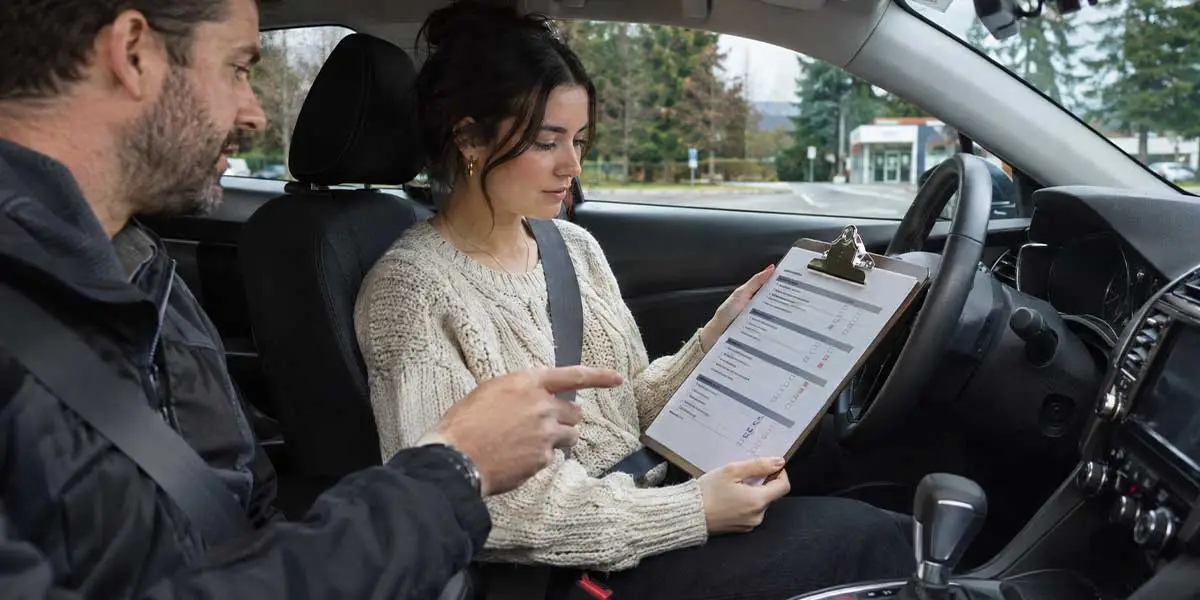
Start with the result box. Check your total demerits, pass or fail status, and any recorded failure reason.
Next, review the marked rows and section totals. Look for errors that occurred repeatedly rather than concentrating only on your overall score.
Left Turn, Right Turn, Road Position, and Vehicle Handling
The updated assessment is organized into four sections:
- Left Turn: Turning position, observation, signalling, yielding, and vehicle control.
- Right Turn: Safe approach, shoulder checks, turning technique, and traffic awareness.
- Road Position: Lane discipline, following distance, speed management, and hazard perception.
- Vehicle Handling: Parking, reversing, steering, signalling, and observation.
For example, repeated observation marks during left turns suggest a different practice priority than errors involving parallel parking. Ask your examiner to clarify unfamiliar markings during the post-test feedback discussion.
Understanding ICBC Road Test Sheet Codes and Driving Errors
Your results should help you recognize unsafe habits, not simply memorize scoring terminology.
Observation, Rolling Stops, Lane Position, and Signals
- Observation: Failing to scan intersections, check mirrors, or complete necessary shoulder checks can lead to errors.
- Rolling stops: Slowing down without stopping completely at a required stop is a common problem.
- Lane position: Cutting corners, turning wide, or drifting from the correct lane can affect your assessment.
- Signals: Missing, poorly timed, or uncancelled signals can result in demerits.
Similar driving errors appear in Ontario’s major mistakes in g2 road test discussions. However, Ontario’s G2 licensing assessment and British Columbia’s ICBC scoring system are different and should not be confused.
ICBC Road Test Scoring: Demerit Points, Cutoffs, and Automatic Fails
Under the updated system, drivers can receive up to 95 demerit points without failing solely because of their total. Exceeding that threshold results in failure.
However, certain rows contain an F cutoff box. Reaching that cutoff causes failure even when the total remains below 96.
A Dangerous Action, qualifying traffic violation, or other disqualifying incident may also result in failure.
Consider these illustrative results:
- 75 demerits, no cutoff or disqualifying incident: Pass.
- 40 demerits, but an F cutoff reached: Fail.
- 100 demerits: Fail.
The key lesson is simple: safe judgment matters more than trying to calculate how many mistakes you can afford.

Using Your Scoring Sheet Road Test Results to Improve Your Driving
A failed test provides useful information when you turn the examiner’s feedback into specific practice goals.
A Practical Practice Plan Based on Your Results
Follow these steps:
- Identify repeated errors. Highlight the categories with the most marks.
- Prioritize safety-related weaknesses. Address observation, yielding, and unsafe decisions first.
- Practise in varied conditions. Include residential streets, intersections, and appropriate traffic environments.
- Complete a mock road test. Check whether improved habits remain consistent without reminders.
For example, if shoulder checks were your main weakness, practise observation before turns, lane changes, and pulling away from the curb. Avoid spending an entire lesson practising parking when your results identify a more important intersection-safety problem.
Road Test Scoring Guide: How to Prepare for Your Next ICBC Test
Good preparation means demonstrating consistent driving habits, not memorizing a particular route.
Before your next appointment:
- Practise complete stops and proper yielding.
- Check mirrors and blind spots before relevant movements.
- Maintain appropriate speed for posted limits and road conditions.
- Review intersection scanning and lane positioning.
- Practise parking and reversing with proper observation.
ICBC’s preparation guidance emphasizes safe, independent decision-making. Examiners expect you to obey traffic laws, recognize hazards, and respond appropriately to changing road conditions.
British Columbia’s updated licensing rules also mean some eligible Class 7 drivers can progress to Class 5 through a driving record assessment instead of a second road test. Requirements depend on individual eligibility.
Prepare With Confidence at Seymour Driving School
At Seymour Driving School, we help learners throughout North Vancouver and surrounding communities develop safe driving habits through patient, personalized instruction. Our lessons focus on practical feedback, confidence, and the driving skills that matter beyond test day. Contact us to discuss your road test results and prepare with a focused driving lesson.
Frequently Asked Questions About ICBC Road Test Scoring
What do the codes on an ICBC road test results sheet mean?
Before October 19, 2026, ICBC used codes such as A1 for shoulder checks, B1 for lane position, and C2 for rolling stops. The updated passenger vehicle marking sheet uses named errors, demerit values, and F cutoff markings. Check which version was used for your test and review the corresponding Skills Explainer.
How many points can you lose on an ICBC road test and still pass?
Under the updated system, a driver can accumulate up to 95 demerit points and still pass, provided no failure cutoff or independently disqualifying incident occurs. A total exceeding 95 results in failure. Certain repeated mistakes, dangerous actions, and traffic violations can also cause failure regardless of the point total.
What are the most common mistakes that cause drivers to fail the ICBC road test?
Common problem areas include missed shoulder checks, incomplete stops, unsafe lane changes, incorrect lane positioning, speeding, and failure to yield. Repeated errors may reach a cutoff, while serious safety incidents can independently cause failure. Practising consistently and reviewing examiner feedback can help drivers correct these weaknesses before retesting.